Sunday, April 18, 2010

A home for the healing

There is a place we send our patients after surgery, after discharge, just a few kilometers into the city. We call it the hospitality center. For those who have traveled far, will need cast changes or follow-up care, and need to stay in Lome. It's a place of song and dance, of happiness and healing.


I went to visit a few weeks ago for the first time...just hopped in the back of a land rover, along for the ride with a few discharged patients. As we walked into the center I wondered just how many patients I would know, how many would still be here and healing. Just a few steps into the hallway I realized it would be quite a few. Smiling fit to burst and hobbling towards us as fast as they could on crutches were three of our discharged patients. Liberty climbed up and patted my cheek as I exclaimed over her walking progress. Bo, who spent 4 days on the ward crying because he thought we had taken away his nice brown legs and given him yovo (white) legs, lost his crutches in the rush over to say hi and just hung on to my legs. Eram, who spent almost a month with us and knew every nurse by name.


We hugged and grinned and chatted - our bits of French and Ewe and their bits of English, and a lot of hand motions all mixed in. And then we headed out to the courtyard. I didn't know it could get even better.
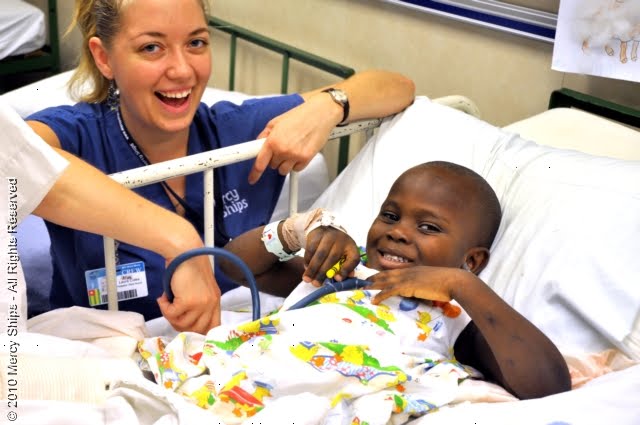

"Tata LAURA (Auntie Laura)," 4 year old Komla started hollering as soon as he saw me. "Bonsoir tata LAURA!!" Mom smiled and waved, and I headed over right away to pick him up and twirl him around in a crazy hug. This was my buddy who sang in the shower in the early morning of his surgery, who was always ready for a high-five and a hug, who looked forward to his Q4hour neuro checks because it meant that I tickled his toes. My token pediatric patient for the high school student shadowing me...as I taught her assessment and nursing skills Komla decided to learn too, and fell in love with my stethoscope. It never ceased to amaze him as I put the rubber tips in his ears and diaphragm on his chest, his whole face lit up and he would shout, "boom boom boom boom" in time with his heartbeat.

He wiggled his toes for me and showed off new candy-cane striped casts with a protective piece of rubber tire on the bottoms. "He walking now," mama informed me. He put his fingers in his ears and asked me, "boom boom?" "Next week," I promised, I would bring the stethoscope.

11-year old Abe waved and politely asked in pantomime if he could borrow my camera. I went over for a hug with him and handshake with dad. Abe had been our star patient for several weeks. He came in with chicken legs - kneecaps far behind his legs and feet jutting forward - a result of antimalarial injections in childhood. He stayed incredibly cheerful through several difficult surgeries, blood transfusions, cobbled-together wound vacs, and a multitude of confusing hospital procedures. Now his legs stick out straight as he proudly hugs his very own water bottle, joining in the balloon fight.

Anna, one of the other ward nurses, pulled out her djambai and we had an impromptu dance/praise party. The dirt pounded up between my flip-flops as I hugged Komla and danced, with him clapping energetically and singing off-key in his little boy voice. The mamas smiled and sang and danced, and asked us how we were. The kids hobbled around crazily on their crutches, showed off whole lips and palates, proudly sported name tags from all the visiting nurses. It was a wild and beautiful afternoon.
These are the kids who had cried, who weren't sure of the yovo nurses that smiled and gave them balloons and promised that they would play soccer again, who we had soothed through nights of pain with a gentle hand, a morphine injection, a quiet evo, evo, babade, baba (it's OK, it's all OK, it's over now). Here they were smiling and running just as fast as the crutches would go. I can just see Jesus sitting here with a few cast-footed kids on his lap, pounding away on the djambai and singing praises to God along with the rest of us, telling the mamas and the babies "see, I am here. I have not forgotten you."

Saturday, April 10, 2010

One drop of blood

...or a pint, if we're being literal, filled the bag resting on a scale beneath the hospital bed. I've done this before. It's not the first time...but this time I know who needs it, and that makes all the difference.

I met Mariam* just a few weeks ago - barely responsive and wilted into the hospital bed a few hours after her arrival on the ship, unable to swallow for a week before that because of a painful growth on her jaw. "We need an ER nurse," my charge nurse said, and so I followed her over from the B ward dance party to a sobering A ward, to the young woman in bed 20. "How are you feeling about your IV skills? She's got just about nothing for veins." I untied the baby from my back, we had a small IV line infusing a few minutes later and I returned to a wild and cheerful B ward praying for the lives in A ward, for the dying cancer patient Vince who was slowly slipping away after a traumatically bloody episode a few nights before, for the skin-and-bones infant a few beds down, little Ana, and for the little mother just a few years older than me who could no longer eat or drink.

Rushed to the ICU a day or two later, Mariam has been with us since then. Despite tests and retests, we're still not entirely sure what's wrong. Why can't she breathe properly, we ask. Where is the fever from? What happened to her electrolytes...and most recently, where did all the blood go?

Out of 400 crew members, there are five of us with Mariam's blood type registered as donors. Two of us donated this morning. The crew is a living blood bank available for patients in need. I put in her new IV in the quiet hours of early morning, knowing it would be my blood infusing through it come sunrise, thanking God for letting me find a good vein on the battered and bruised arms, for the one IV catheter from home that slid in so easily.

They walked it down the hallway after the tubing was clamped and cut, a double handful of life to infuse, still warm, into Mariam's veins. A few hours later another nurse donated another unit, allowing Mariam's body to find some relief and rest now that it has a bit of blood again.

It is a privilege to donate for someone that I know. To share my life and heart with hers, to know that I am truly making a tangible difference in her life. To feel the sore prick in my inner elbow and be reminded to pray for her and her family, for her attentive husband who held his own prayer service at the bedside day by day, for her small son that needs her home again. Because I know that even more important for Mairam's life is a need for realization that what she needs to accept is not a gift of human blood for transfusion, but the free gift of Christ's blood for sacrifice. In the end, that is what will be the difference between life and death, both in her life and in mine.

"For you know that it was not with perishable things such as gold or silver that you were redeemed from the empty way of life handed down to you from your forefathers, but with the precious blood of Christ, a lamb without blemish or defect." 1 Peter 1: 18-19

*Patient names in all my posts may be changed to protect patient privacy.

Tuesday, April 6, 2010

For the least of these


She smiled up at me as I rocked her and sang, an empty smile. The weight in my arms was all cloth and casts, and almost no baby. Little Abbie had been born a premature twin, the cord wrapped around her neck. "She wasn't breathing for a long time, maybe 5 minutes"mama told us, stolidly accepting that her baby might never be normal. Both little feet turned in, clubfeet slowly but steadily being corrected by progressive casting. Both she and her twin weighed in at a whopping 1.8 kilos that morning, all of 10 days old.


"The King will reply, 'I tell you the truth, whatever you did for one of the least of these my brothers of mine, you did for me." Matthew 25:40


The infant feeding program aboard is full of these stories - tiny children with cleft lip or palate who fail to gain weight, who cannot suck on a bottle, who inhale their milk like little Ana and die, or who stay alive through only sheer force of a mama's love and persistent prayer. We've sent one home now, dimples in the rolls on his knees, and sutures through the broken lip once he had gained enough weight for surgery. Two others on the ward this week are in stark contrast to each other, one now a chubby baby cheerfully waiting for a lip repair, the other on all of our hearts as he deteriorated slowly before our eyes...


Every muscle in his little chest and face pulled in, then out, working harder and harder to supply the tiny body with enough oxygen. Breathing 50, 60, 70, 80 times a minute, I wondered how long it would take before he suddenly...stopped. We prayed as we cobbled together an infant CPAP mask from anything we found in the pediatric drawer of the code cart, prayed as we held it to his face, thanked God as he started to kick and fight and struggle again. At 4 months old, Brian (not his real name) weighs barely over 6 pounds. Mama lovingly feeds him every two hours, a small syringe of milk down the feeding tube in his nose, somehow curled around and through the split lip and palate, down into the stomach. I was told he had been having some trouble over the last few days; now, only an hour into my shift, I had the sinking feeling that we were losing this little boy, losing another baby during the already heartrending Easter week.


We transferred Brian a half hour later to the Intensive Care Unit - to a ventilator that had miraculously arrived a week before and could provide continuous mask ventilation support to the tired lungs. I went with him, now suddenly turned into a pediatric ICU nurse, praying for all I was worth. He was an island in the huge ICU bed, tubes and monitoring wires in every direction. Only an hour later he peeked out around the coban that held the mask to his face, interacting with mom, breathing slowed to only 40 times per minute.


We call him the miracle baby. Not because of that long afternoon shift, and not because of anything that we have done. They told me that later in the night he again started having breathing difficulty despite the machine support. As the nurses prepared for intubation and the doctors discussed whether he would ever come off of machine support, the surgeon simply laid on hands and prayed. And seconds from intubation, suddenly Brian was fine. Breathing slowed, eased; oxygen saturation came back up to 100% with only a little blown by his face. No breathing tube, no mask, no problem. Things like that don't just happen. Babies don't go from acute respiratory distress to a sudden...calm.

I started this post a few days ago, planning to ask for prayer for little Brian, for our tiny feeding program babies. I am still asking for, pleading for prayer for this little one and a thousand others. But I do so with a full heart, knowing that our prayers are already being answered in incredible ways. He still cares, even for the least of these his children.


Friday, April 2, 2010

To save a life

A life saved…
There are the moments of adrenaline ... of holding a bleeding artery under gloved hands to stop the wild spurting, of chest compressions riding down the hallway on a stretcher. Of squeezing a bag to watch a chest rise and fall, of giving a drug and watching a heart slow, slow again back to normal...another life saved.
Here there is another, a quieter lifesaving that goes on day by day, moment by quick moment in the sterile rooms of the OR. Tumors that would take a life – by slow poison, by choking or starvation, by bleeding and bleeding until there is no blood left. It’s like watching an artist at work, I thought, watching our maxillofacial surgeon explain his repair as he sewed. The same hands that take out that tumor piece together a face again.


4-year old Esther showed up at the eye clinic with a cancerous tumor growing inside of her eye. That afternoon the opthamology team took out her eye and the tumor, giving her a chance to live past 5...another life saved.

Afi was starving. The tumor that had been growing for eight years now left her only a small mouth hole to spoon in porridge, to squirt in water by the syringe-full. Down to the size of a child, she was slowly starving to death. When she came in she had little blood left – we heard another crewmember called overhead, and another…paged to donate pint by pint a replacement for the bucketfuls lost. As of this week she now has blood, she has a mouth, and she has hope.


And there is the renewal of hope - a soul hidden in bright layers of shame along with a disfigured body finally now daring to come out into the open. A blind woman, seeing the world for the first time. A baby gaining weight despite a broken face, with the possibility of life, marriage, children, community...another life saved.

A life lost…
She bleated pitifully as I looked for a vein, any vein, in the shriveled arm that waved at me from a nest of bright African cloth. Words like failure to thrive, cleft palate, possible metabolic problems…all these fade off into nothing in the stark reality of the here and now. At just over a year, Ana weighed about as much as a newborn child. A drastic comparison to the chubby baby pictures from her cleft lip repair last year.
Ana went home two days later. A home where she is fat and happy and crawling. Where no one looks at her and calls her cursed. Where she thrives! Here we grieve for her and her family…knowing that our best was not enough. But was it? Was it enough to know that she is loved, that she is wanted, that now her broken face and body are whole? In the end, each life is in God’s hands.
We came to Africa to bring God’s hope and healing, they tell us. Nurses save lives, we say. Only God can save lives; sometimes he chooses to take them home.

What is life but a gift? Years, months, days…they are each one in God’s hand.

Tuesday, March 30, 2010

Je m'appelle Afua

I roll out the magenta playdoh into strips, slowly spelling out phrases. Je m'appelle AFUA, I wrote on the bedside table...My name is Afua. Like so many West Africans, I now have been named for the day I was born...inflection and name slightly different depending on people group and language. You are Friday-born?, they ask with a smile...who gave you this name? I tell them my Ghanian brothers from Mercy Ships have given me this name and told me it is Ashanti. Ahhhh they sigh, in understanding and delight that a yovo woman would choose to have a name like theirs. Brown hands turn my name tag over, running a finger along the medical tape I've put there with my African name just above my own, sounding it out again. I point out the other nurses...This is Afivi, Afigan, Ama, and Aqia. You see, we are not so different from you...


9-year old Kofi calls me across the room, running my names together into one. AfuaLaura, he calls happily. He is balanced on a stool, one casted leg stuck out in front of him with crutches thrown carelessly on the floor, drawing with sharpies. As I turn to look, he shows me his cast, on which he has carefully listed every staffmember involved in his care – from “Dr Frank” the surgeon, every nurse on our ward, and one of the crewmembers that comes often to visit. The other side proudly displays a huge ship, with “Mercy Ship” and his name inside. I give him a thumbs up and c'est bon, and draw a smiley face on the foot, telling him, “This is you, Kofi, with your happy smile that lights up the ward!” He giggles and offers me an energetic high-five and a hug.


They say that only 10% of communication is actually done through words. Working here, I could believe it. Smiles, gestures and facial expressions play so much into our lives here...sometimes when the translators are busy I can hold entire conversations with just a few words in French, or none at all. The part of me that wants to chatter away reassuringly to my little ones makes do with a smile, a headrub, and teasing pinch of casted feet.


It’s not a name, or a language that truly matters. It is a belonging. With a people that have been rejected by village or family, with the castouts and thrown-away children. In us, they have found a place that they can simply be loved, be healed, and a chance at new life. In them, we have found a whole community to love and learn from.

Friday, March 26, 2010

What is trust?


What is trust? Can I count the unknown for these people, many of whom have walked from remote villages or come long distances with only the hope of change? We are a different color, a different language. The ship is different and the food is strange. There are lights that turn on and off, toilets that flush, showers that spray. We distill complex medical procedures down into simply "tomorrow they will give you medicine to make you sleepy, and fix your leg so it is straight."


As I continue in this vein, I get solemn nods from 4-year old Kwabena in my lap. "You will not be able to walk on your leg for a little while, and it will be in a long hard cast." I point to the boy in the bed next to him, legs already in bilateral casts, Kwabena nods. "We will tickle your toes to make sure that you can feel them, and ask you to wiggle them, and give you medicine if it hurts." Nod. "We will listen to your heart and check your breathing...would you like to hear your heart?" Nod...and an ever so shy smile of wonder as he listens to the steady beat of his own heart. The doctor has already discussed basics of surgery with mom, it is my job to explain pre- and post-surgical basics. She nods and smiles, no questions. Diagnoses of genu varus and a treatment plan of tibial osteotomy mean nothing to her. Jesus brought us here, tomorrow the doctor will fix her little boy's leg, and that's all she needs to know. Bored with the serious talk, Kwabena hops up and runs off on crooked little legs to resume his lively soccer game through the ward with another nurse and dimpled little boy.

"Will you let me carry you?" The elevator had broken again yesterday and was working slowly today, bringing our kids up to deck 7 and out into the sunshine. Two days of enforced bedrest had turned two of our lively and cheerful little girls into screaming, fighting, and bored out of their minds. Two-year-old Grace stared back at me out of her nest of pillows. Pigtails stood up everywhere and casts jutting out in the air. Earlier today she had tried to bite me, angry and in pain, and scared. Our translator had gone with the first crew after inviting mom to come up as well. Limping herself, mom is in no shape to carry her little girl up and down 4 flights of stairs.

I point at myself and Grace, make a carrying motion with my arms, then point to the ceiling. "Grace, I know I'm tall and white and smell funny...will you let me carry you outside?" Mom nods and smiles. I pick up the tense little body, one arm cradling the stiff white casts. "Evo, evo Grace," I murmur, "everything will be all right." She peeks a few times over my shoulder, checking that mom is following up the stairs, then curls her little arm around mine and looks up at me. The other fist is clutching tightly to her large pink balloon.

Upstairs on deck there are people everywhere. Patients with tumors and ones that used to have them, heads no longer wrapped in shame. Children in casts are on laps and chairs, batting around their balloons. A boy in a flowered patient gown races wildly along the deck and into my leg, looks up and giggles. Soon no one will be able to tell that there used to be a hole where his upper lip should have been.
As we prepare to go back down for dinner, I hear "sssss Afua, sister!" Grace is crying as a translator tries to pick her up, mama calling me over. "You take her, Afua," mama tells me. And just like that she is in my arms, one chubby arm hanging on tight to mine, and head resting against my shoulder. "Can I carry you, Grace?" She grins up at me, pats my white cheek, then snuggles down again in trust.

So many of the staff here have left jobs and settled lives and friends at come to come, if only for a little while. To come and serve in obedience. To make some small difference in a life, of two, or a thousand. To be Jesus to a child in need.

It's not an easy thing to leave the known. To boldly step out into something completely and wildly new. I know for myself, in taking this one small step, I have been allowed a glimpse into what life could be...a life of trust.

Monday, March 22, 2010

Akloa

My head bobbed as we hit another bump in the road. I woke up just enough to catch myself from falling into the lap of the man next to me. Heat pounded up through the floor under my feet, along with the smell of burning rubber and exhaust. The rearview mirror drooped from the ceiling, a tired swing with each pot hole. With a loud crack we lost half of the side mirror, and I realized we had left it back on a projecting tree branch. The engine coughed, coughed again, and stopped. As we coasted downhill the driver enthusiastically revved the engine until it finally turned over and started again. We picked up speed as Bo threaded his way through a series of potholes...the ultimate slalom ski course. Barefoot brown children wearing only a pair of shorts, every rib visible, ran out of leaf-thatched huts to happily wave and chase along the road shouting "Yovo, yovo!!" Apparently, a bush taxi full of yovos was not a common sight along this road.

After working a night shift friday, I joined a group of friends for a hiking trip to Akloa falls, Togo's highest waterfall. Eight of us yovo girls piled into a dilapidated van (fondly referred to as a "bush taxi") for the 6 hour drive after a lively haggle session at the bus station. After the first few stops wondering how many people we would be fitting into a 9 seat van, we finally stopped wondering and just started joking, counting and enjoying the ride. We made it up to 18, a solemn child on my lap patting my waterbottle as we tried out our French and Ewe, and they, their broken English.

After a warm and sweaty hike (well hey, it's Africa...what did you expect!) to the waterfall the next morning. We tramped on a (slightly muddy) winding trail through green meadows and groves of banana and mango trees. The thickly forested mountain rose on either side, swathed in cloud.

"Like something out of a shampoo commercial" says a Togolese website. It does not even come close to the majestic beauty of the 115 ft cascade. A rush of breeze tickles wet hair, the soothing rush of water far different than the growl of diesel engines. This too, is Africa.

After enjoying the photos of the beautiful Badou region and Akloa hike along with our adventurous bush taxi ride above, check out some of the fun Africa photos below...more photos to come as my friends upload theirs!